Key Takeaways
- “Permanent outdoor lighting” covers two distinct product categories — eave-mounted LED puck lights for color and holidays, and brass landscape systems for year-round architectural lighting. Knowing which one you want before you shop saves you from buying the wrong thing.
- Design comes before fixtures. Buying first and designing second is the single biggest reason DIY systems look uneven once installed.
- Transformer sizing makes or breaks a system. Never load a transformer above 80% of its rated capacity, and build in extra headroom if you plan to expand later.
Who This Article Is For
- North Dallas homeowners who want their property lit professionally every night of the year, not just during the holiday season.
- DIYers who are ready to install their own low-voltage landscape system and want to understand the process before spending money on fixtures.
- Homeowners who have seen a neighbor’s lighting and want to understand what type of system it actually is before calling anyone.
What Permanent Outdoor Lighting Actually Means
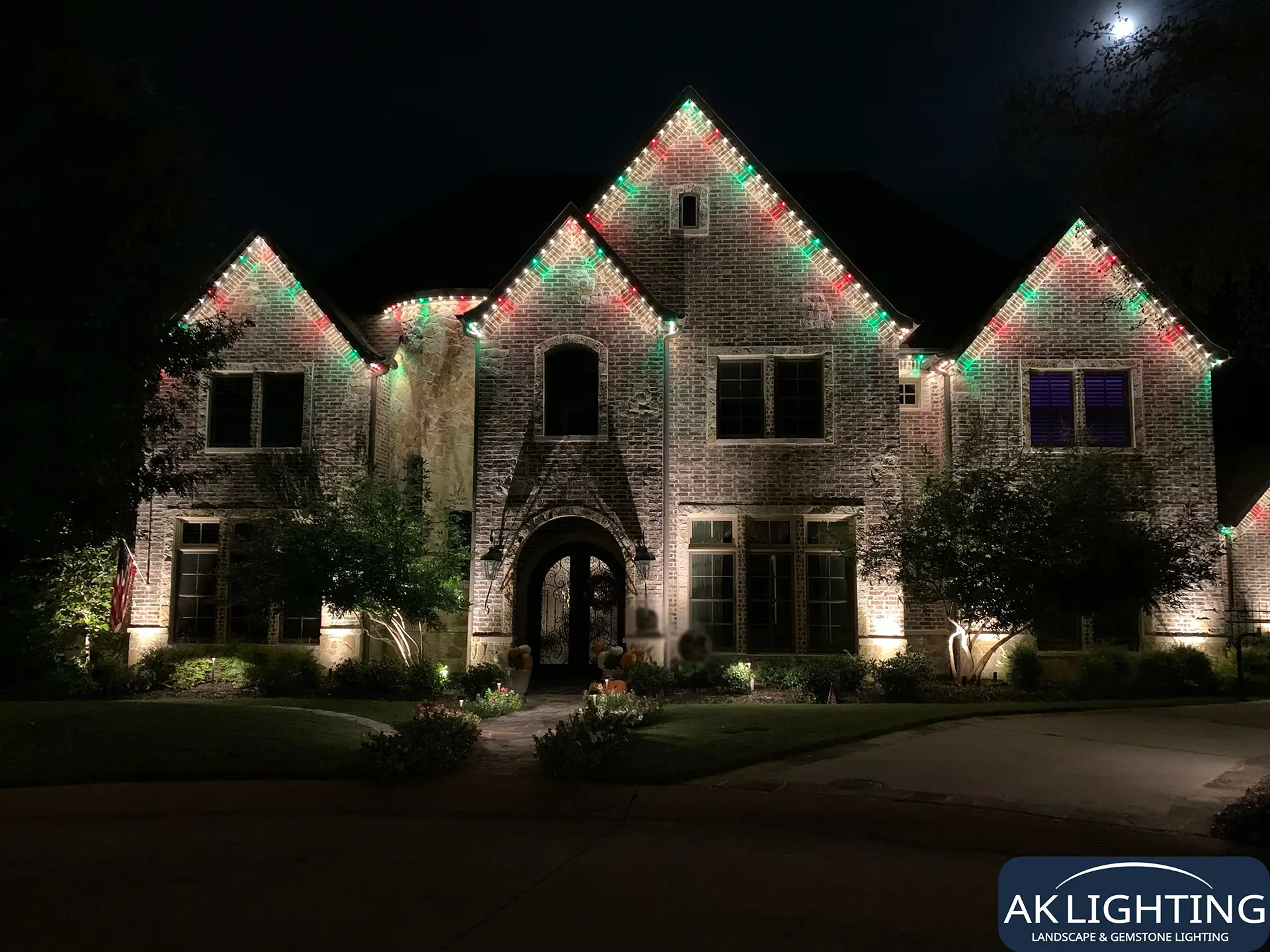
Most people searching this term are picturing two completely different products. One is an eave-mounted LED puck light you control from your phone, including color changes, holiday scenes, music sync. The other is a low-voltage brass landscape system wired into your property and designed for your specific layout. It’s built to run every night of the year for fifteen years without touching it.
We’ve installed more than 500 of these systems in North Dallas over the last ten years. In this article, we’ll walk you through both categories, explain what separates a permanent system from a product on a shelf, and tell you how to build one that actually lasts.
The Two Types of Permanent Outdoor Lights
Before anything else, you need to know which type you’re shopping for. They serve different purposes entirely.
Eave-mounted puck lights are what most consumer tech publications recommend: pixel-style LED strips or puck lights that mount under your roof eaves with included screws or adhesive strips. They connect to an app, support voice control through Google Home, Amazon Alexa, and Samsung SmartThings, and can cycle through hundreds of color scenes or sync to music. Most carry IP65 or IP67 weatherproof ratings, which means rain won’t kill them. You can cut and splice most sets to fit your home’s roofline around peaks and gables.
These lights are great for holiday displays and outdoor parties. They’re fun and they work. If your home has flat eaves, access to an outdoor outlet, and you want something you can control from your phone for every occasion, they’re a reasonable purchase.
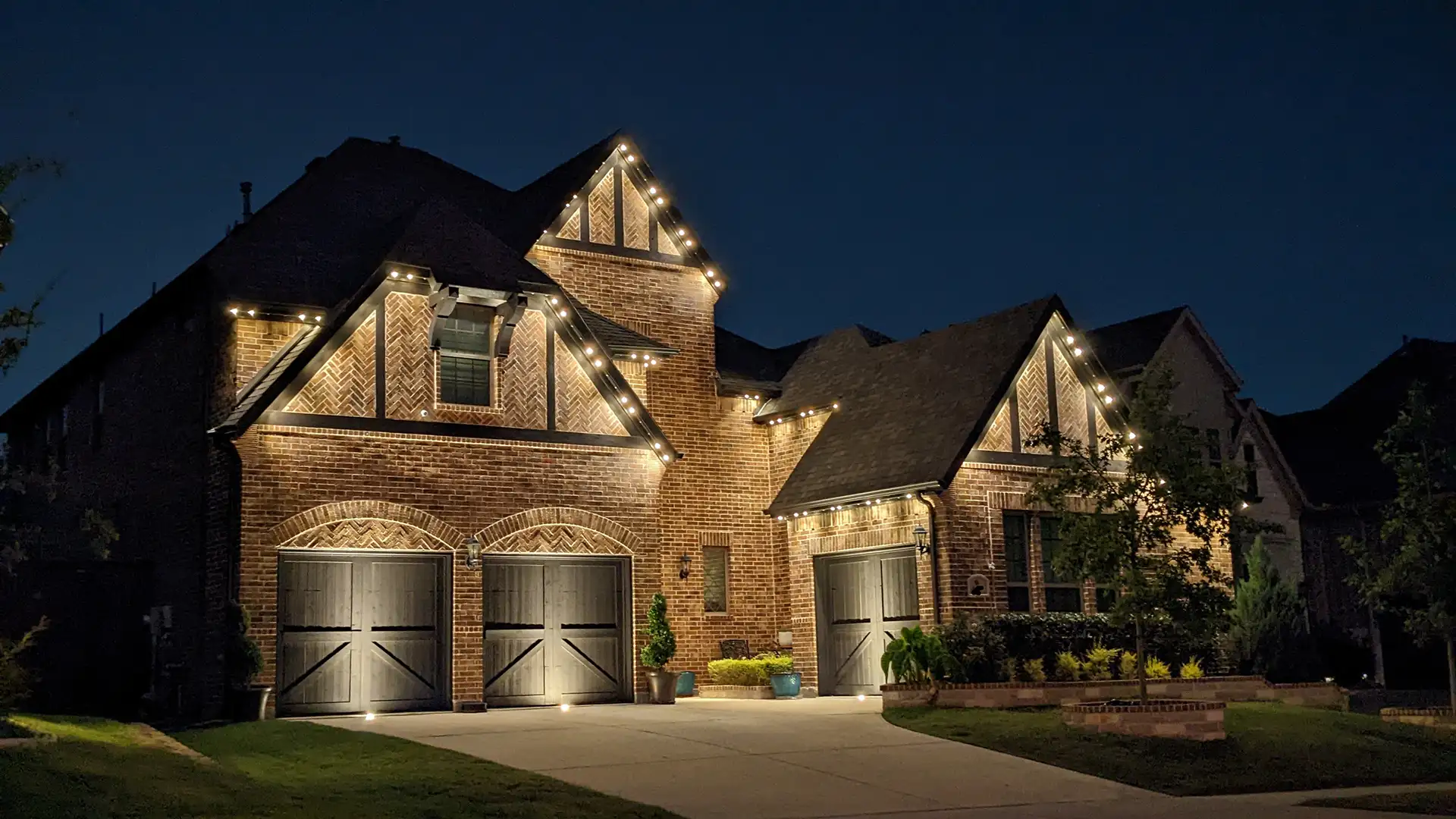
Brass landscape systems are a different product category in every respect. These are fixed low-voltage fixtures: path lights, uplights, well lights, step lights, gutter accents, wired directly into the ground and powered by a transformer. They are then left in place permanently. They light your property the same way every night, but that consistency is the point. A properly designed system makes your house look like it was meant to be lit that way. The lights disappear into the property during the day and do their job after dark without you touching anything.
That’s the product we work with. Everything below applies to brass landscape systems specifically.
Why Design Comes Before You Buy a Single Fixture
This is where we take a position that most people don’t expect from a company that sells lighting. Design comes first, and purchasing second.
We’ve walked onto too many properties where a homeowner ordered fixtures based on photos online, then tried to build a design around what they already owned. It never works as well. The design tells you what fixtures you need and exactly where they go. Buying first is backward, and it’s the single biggest reason DIY systems look uneven once they’re installed.
We walk every property at night first. Daylight hides what matters: where shadows fall, which trees have canopy worth lighting, which architectural features go dark once the sun drops. That night walk is where the design happens. Everything else follows from it.
Why Box Store Fixtures Don’t Belong in a Permanent System
The fixtures you find at a big box store are almost always plastic or thin aluminum, built to a price point rather than a lifespan. We’ve tested more than 100 fixture types over the years. The pattern holds every time: plastic housings crack, corrode, or fog over within one to five years of Texas heat and sprinkler exposure.
Brass doesn’t do that. A solid brass fixture develops a patina instead of falling apart. It’s rated to run 15 years or longer with basic upkeep. The fixtures we install are Dauer brass, and every one carries a five-year warranty because the manufacturer knows they hold up.
When you run the math, a box store fixture at $20 that dies in two years costs you more over a decade than a $150 brass fixture still running when your kids graduate high school. The sticker price at checkout is the only number most homeowners compare, and that’s exactly why they replace the same lights twice.
The Four-Step Installation Process
Every system I install follows the same four steps. Skip one and something in the system will fail.
- Step 1: Design. Walk the property at night. Sketch the layout, count fixtures per zone, and calculate total wattage before purchasing anything. This step alone prevents most of the mistakes I see on DIY installs.
- Step 2: Select fixtures. With the design finished, build the actual shopping list. Path lights go 12 to 14 feet apart in a gentle zigzag. A straight line looks like an airport runway. Uplights on mature trees over 40 feet need the super bright 12 to 16 watt option to reach the canopy. Gutter and eave accents run on low 2-watt fixtures so they read as a soft wash rather than a spotlight. This is also where you size the transformer, and it’s where most DIYers get into serious trouble.
- Step 3: Install. Plan your wire runs before you dig a trench. Lay the wire along its full path and test every connection before burying anything, because finding a bad splice after backfilling means digging it up again. Every connector goes into a waterproof DryConn or King Innovation GTSR. No exceptions. A connection that lets in ground moisture will fail within a season.
- Step 4: Adjust. Come back after the first or second night and walk the property again once it’s dark. You will find a hotspot on a fixture aimed too close to a window, a tree with glare instead of a soft wash, a corner darker than it should be. Adjusting aim and position after you’ve seen the system running at night is what separates a professional-looking result from a “good enough” one.
Almost every DIY guide leaves out Step 4.
The 80% Rule
The one calculation that prevents the most expensive mistake. Undersizing the transformer is the costliest mistake I see, and it’s completely avoidable with one number.
Add up the total wattage of every fixture in your system, then multiply by 0.80. That’s your safe load limit. Never run a transformer at full rated capacity, doing so shortens its life and can trip the system on hot nights when demand peaks.
Transformers come in three practical sizes for residential systems: 150 watts, 300 watts, and 600 watts. A 300-watt transformer should carry a maximum working load of 240 watts. Round up to the next standard size, and build in a 40 percent buffer beyond your current fixture count if you plan to add landscaping later. Buying the right transformer once is far cheaper than replacing an undersized one two years in.
Common Mistakes That Shorten a System’s Life
Plastic fixtures are the number one problem, for the reasons above. Skipping the design walk leads to uneven coverage nearly every time. Using standard wire nuts instead of waterproof connectors guarantees a failure point within a year or two of rain. Running 14-gauge wire on long runs causes voltage drop. Fixtures at the end of a run look noticeably dimmer than those near the transformer, and most homeowners never figure out why.
Using 12-gauge wire throughout is the only right answer. No guesswork on gauge.
Frequently Asked Questions
Is permanent outdoor lighting the same as permanent Christmas lights?
No. Permanent Christmas lights (the Govee and Eufy puck systems) are colored LED strips mounted to your roofline for holiday display and year-round color changes. A brass landscape system is a fixed low-voltage system for architecture, trees, and walkways that runs every night of the year with a consistent white or warm light. They’re different products serving different goals.
Can I install a permanent lighting system myself?
You can. I built my $197 DIY Course specifically for that. The process is the same four steps I use professionally: design, select fixtures, install, and adjust. Most DIY failures come from skipping the design step or using the wrong connectors.
How long do the fixtures last?
The Dauer brass fixtures I install carry a five-year warranty and typically run 15 years or longer with basic maintenance. Plastic box store fixtures usually fail within one to five years. The lifespan difference is roughly tenfold.
Do these systems connect to smart home platforms?
The transformer I use connects to a smart app and can run on schedules, but it doesn’t integrate with Google Home or Amazon Alexa the way eave-mounted puck lights do. Smart home voice control is a feature of the colored LED eave systems. The two categories are built differently, and trying to cross those features over is a recipe for choosing the wrong system.
Where to Go From Here
Permanent outdoor lighting covers two distinct categories. If you want color, music sync, and a light show for every holiday and outdoor party, eave-mounted puck lights are the right answer. If you want your property lit professionally every night of the year with fixtures that last fifteen years, that’s a brass landscape system, and the design comes first.
Start with our free Starter Guide or book a Personalized Design Service, and we’ll walk your property the same way we’ve walked more than 500 others across North Dallas. Book your free design consultation.